

You meant to give the pill. You really did. But the morning got away from you, your partner assumed you'd already done it, and by the time anyone checked, the schedule was off. If that sounds familiar, you are not a bad pet parent — you are a completely normal one. And the research proves it.
Across multiple peer-reviewed veterinary studies, roughly half of all pet owners do not give medication exactly as prescribed. This guide explains what the science actually says about why doses slip through the cracks, why shared households are especially vulnerable, and how to build a simple system that keeps your dog or cat on schedule without the daily anxiety of "wait — did anyone give it?"
The same failure shows up long before any chronic diagnosis. A first-year vaccine course runs on spaced intervals where both the gap between doses and the finish date matter, and a booster that drifts is a call to the clinic rather than something to fix at home — which makes the puppy vaccination schedule most households' first encounter with a timetable that does not forgive guesswork.
Key takeaways
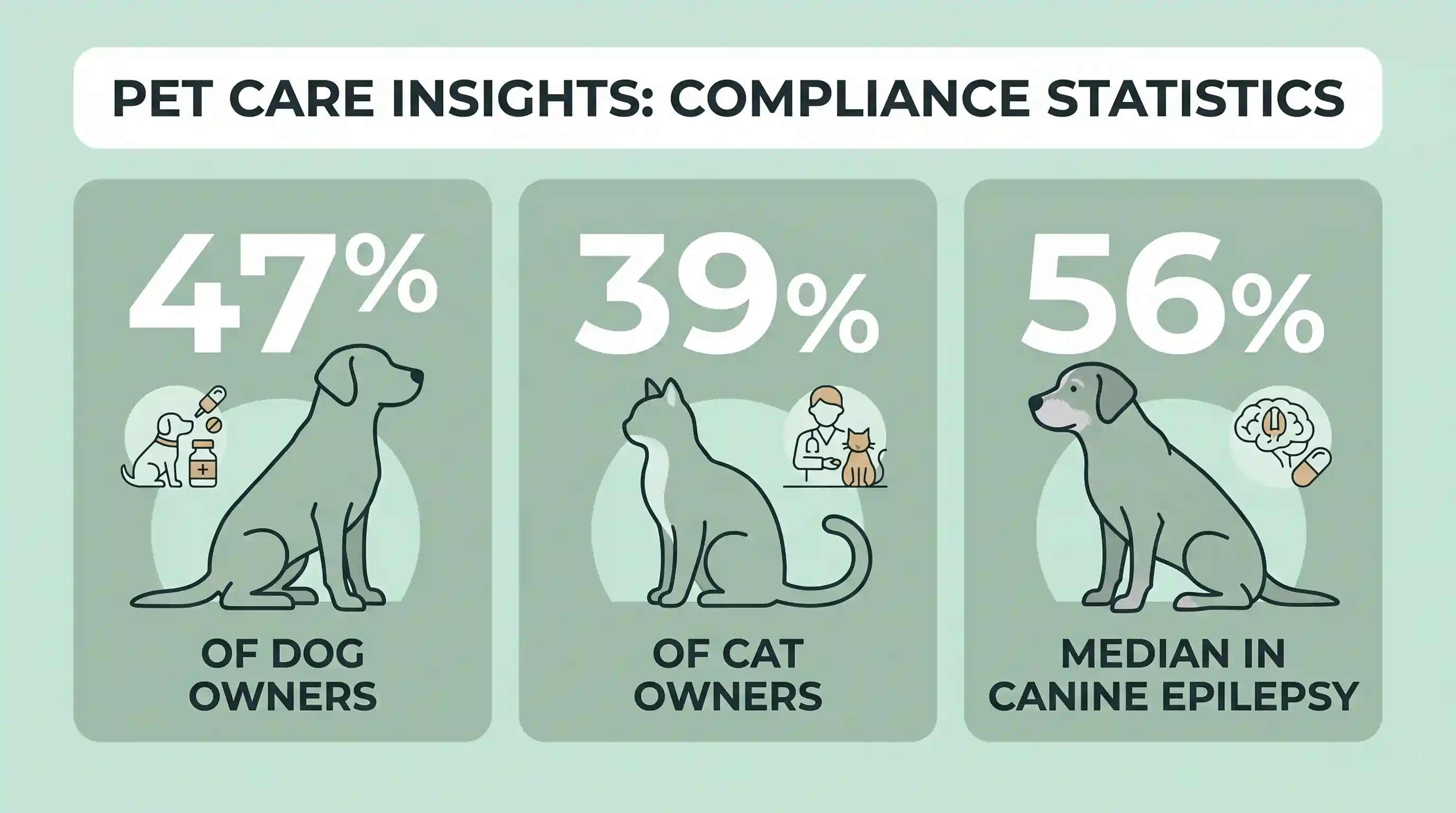
- ~50% noncompliance is the norm. A 2024 study found 47% of dog owners and a 2025 study found 39% of cat owners did not medicate as prescribed.¹²
- Timing is the silent failure. Electronic monitoring shows owners give the right number of pills far more often than they give them at the right time.³
- Simpler beats stricter. Once- or twice-daily dosing made owners up to 9× more likely to be fully compliant than three-times-daily dosing.³
- Shared households need shared visibility — a single, real-time log is the most reliable fix for both missed doses and double doses.
How common are missed pet medication doses, really?
It is tempting to assume that "most people manage fine." The data says otherwise. When researchers measure adherence objectively — with pill counts, prescription-refill records, or electronic monitoring caps that log every time a bottle is opened — the gap between what is prescribed and what is actually given is large and consistent:
| Study | Population | Key adherence finding | Year |
|---|---|---|---|
| Hill et al.¹ (New Zealand) | Dogs | 47% of owners noncompliant; nearly half said no one showed them how | 2024 |
| Odom et al.² | Cats | 39% of owners noncompliant; oral antibiotics and a resistant pet were top risk factors | 2025 |
| Booth et al.⁴ | Dogs with epilepsy | Median compliance just 56%; only 21% gave every dose, ~6 days missed per lapse | 2021 |
| Adams et al.³ | Dogs (antibiotics) | Correct pill count ~91% of the time, but only 64% of doses given on schedule | 2005 |
For context, this mirrors human medicine, where the World Health Organization and others estimate average medication adherence sits around 50% for chronic conditions.⁵ Pet owners are not unusually careless — they are facing the same fundamental problem every human household faces, plus a patient who can't remind them and may actively resist.
What are the five real reasons doses get missed?
Understanding why doses slip is the key to fixing it. The research and clinical experience point to five recurring culprits:
1. Ordinary life simply gets in the way
The single biggest driver isn't neglect — it's that the dose has to compete with school runs, commutes, meetings, and bedtime. Clinicians describe this plainly: even highly motivated owners miss doses because routines are fragile and memory is unreliable.⁵ A reminder that lives only in your head is the weakest possible safeguard.
2. Shared households create "I thought you did it"
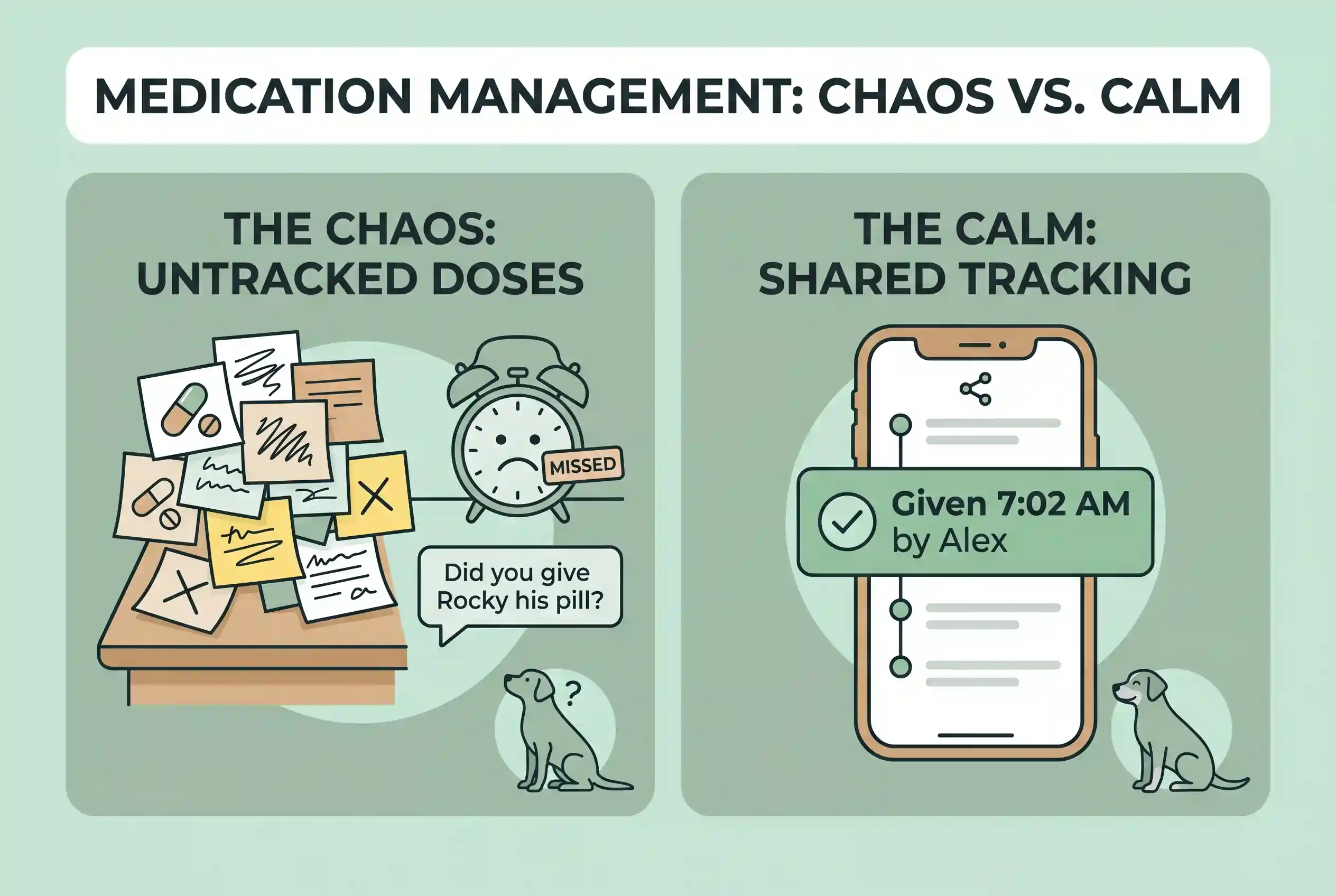
When two or more people share care, ambiguity becomes the enemy. You leave for work at 7:15 and give the pill on your way out. Your partner wakes at 7:30, sees the dog hovering by the medication cabinet, and assumes it was forgotten. Now you've got a missed dose or a double dose — and neither caregiver knows which. Without a shared, real-time record, every handoff is a guess.
3. Complex schedules are hard to sustain
The evidence here is striking. Owners giving medication once or twice daily were up to nine times more likely to be fully compliant than those on a three-times-daily schedule.³ In one study of canine ear infections, simply switching from twice-daily to once-daily dosing lifted compliance from 21% to 79%.⁶ Every extra dose per day is another opportunity to forget — which is exactly why 8-hour insulin or anti-seizure schedules are so unforgiving. Levetiracetam is the clearest case: it clears so fast that it has to be given three times a day, and a missed Keppra dose leaves a wider gap than the drug was ever meant to cover. Epilepsy is where this has been measured most directly: a prescription-monitoring study of dogs on anti-seizure drugs found median owner compliance of just 56%, and our guide to a forgotten phenobarbital dose works through what that gap actually does to the drug level.
4. The pet fights back
Roughly one in three dog owners and a quarter of cat owners report real difficulty administering medication, most often because the animal resists.¹² A struggle every dose turns medicating into a dreaded chore, and dreaded chores get postponed — or quietly skipped.
5. There's no system — just memory and sticky notes
Paper charts on the fridge, a note in one person's phone, a group text that goes unanswered during a meeting: these are the tools most households rely on, and they all share the same flaw. They aren't synchronized, so they can't tell a second caregiver what the first one already did. As one veterinary technology review put it, when the supporting systems are decades behind the problem, low compliance is no surprise.⁵
What about the flip side — accidental double doses?
Missed doses get the attention, but their twin — the accidental double dose — is often more dangerous. In a shared household, the same visibility gap that causes a skipped pill can just as easily cause two caregivers to each administer the "missing" dose. For drugs like insulin, anti-seizure medication, and heart medication, a double dose can be a medical emergency — which is why, with a missed insulin dose, the shot given to catch up carries more risk than the one that was skipped. For others it depends entirely on which formulation is in the cupboard — our drug-specific walkthrough of a doubled gabapentin dose shows how much that one detail can change the answer. The situational drugs are the easiest of all to double, because nobody has a routine around them — a doubled trazodone dose typically comes of two people both remembering the pre-thunderstorm tablet. The once-a-month drugs are the same failure stretched thinner: a doubled NexGard chew usually happens because a flavoured flea chew handed over like a treat leaves neither a routine nor a blister pack to check against. And with heartworm prevention the two failures finally separate, which is why a doubled Heartgard chew is the one case in this list where the missed dose is clearly the more serious half — the drug clears larvae already picked up, so a second chew repeats work already done while a gap lets larvae reach a stage no preventive can touch. The cardiac drugs invert that again: a forgotten Vetmedin dose matters because pimobendan banks nothing between doses, so the gap is real even though the drug itself has long since cleared. One drug adds a failure mode none of the others have: where the prescription itself changes frequency partway through, the household has to remember not just whether a dose was given but which schedule it is on, which is why a doubled Apoquel dose is so often a calendar error rather than a memory one. And the behavioural drugs are the hardest of all to audit, because nothing about the animal that evening reveals what happened: a forgotten fluoxetine tablet produces no visible sign, has no routine blood level behind it, and is judged only at a review eight weeks later — by which point the dosing record is the sole evidence of what was actually given.
We cover this in depth in our guide on how to avoid double dosing your pet's medication — but the headline is simple: the cure for both problems is the same. A single shared record that updates the moment a dose is logged eliminates the ambiguity in both directions.
Important medical disclaimer: SteadyTails is a tracking and coordination tool. It does not provide veterinary advice, diagnosis, treatment, or dosing recommendations. Never change a dose, double up to "catch up" a missed dose, or alter a schedule without explicit instructions from your veterinarian.
Stop asking "did you give the pill?"
SteadyTails keeps every caregiver on the same page with a shared, real-time care timeline — so a dose logged on one phone instantly updates everyone else's. Join the waitlist for early access on iOS and Android.
Join the SteadyTails waitlist →How do you build a household medication system that actually works?
The good news inside all this research: noncompliance is highly fixable, because most of it is structural, not personal. You don't need more willpower — you need a better system. Here is a five-step framework, drawn straight from what the studies say improves adherence.
- Create one shared source of truth. Replace memory, sticky notes, and group texts with a single record every caregiver can see in real time. This is the highest-leverage change you can make and the one that fixes both missed doses and double doses at once.
- Log every dose the instant it's given. Don't wait, and don't rely on "I'll remember to tell them later." When the dose is logged immediately, a shared system can suppress the reminder on everyone else's device — so no one re-gives it, and everyone can see it's done.
- Simplify the schedule with your vet. Because fewer daily doses sharply improve adherence,³⁶ ask whether a once- or twice-daily formulation exists for your pet's medication. Never change timing on your own — but it's a worthwhile conversation at your next visit.
- Make administration easier. Since a resistant pet is the most-cited barrier,¹ ask your vet to demonstrate technique, and ask whether pill pockets, compounding into a flavored liquid, or food-based delivery is appropriate. Nearly half of owners say no one ever showed them how — don't be in that half. Our step-by-step guide on how to give a dog or cat a pill without the fight walks through every method.
- Keep a vet-ready history. Logging isn't just for today's dose; the running record lets you and your vet spot patterns — a string of late evening doses, a dip in appetite, a cluster of missed days — and adjust the plan with real data instead of guesswork. That record matters most where the drug is titrated on a blood test timed to the dose, as levothyroxine is — a missed thyroid tablet can make the next result uninterpretable, and the dose gets set on it anyway. Our guide on how to prepare for a vet visit shows exactly what to bring and ask so that history gets used.


Condition-specific guides: precision where it matters most
The framework above applies to every pet, but some conditions demand extra rigor because the cost of a missed or mistimed dose is so high. If you're managing one of these, start here:
- Tracking insulin shots for a diabetic dog — why 12-hour timing and food coordination are non-negotiable, and how to prevent hypoglycemic double doses.
- Managing strict seizure medication intervals — keeping anti-epileptic drug levels steady on 8- and 12-hour schedules, plus what to record in a seizure diary.
- What to log for a cat with chronic kidney disease — fluids, appetite, and nausea tracking that builds a genuinely vet-ready history.
- How to avoid double dosing your pet's medication — the shared-household safeguards that stop the most common at-home medication emergency.
The bottom line
If you've ever missed a dose, you're in the statistical majority — about half of all pet owners are right there with you. But that number isn't a verdict on how much you love your pet; it's a verdict on the tools most of us are using. Memory, sticky notes, and group texts were never going to win against a busy household and a patient who can't remind you.
Swap the guesswork for a shared, real-time system, and the daily anxiety of "did anyone give it?" simply disappears. That's exactly what SteadyTails is built to do.
Bring shared certainty to your pet's care
Invite every caregiver, log doses in one tap, suppress duplicate reminders automatically, and export a vet-ready history. SteadyTails is coming soon to iOS and Android — reserve your spot free.
Get early access →References
- Hill KE, et al. Factors Associated with Medication Noncompliance in Dogs in New Zealand. Animals (MDPI), 2024. PubMed Central (free full text)
- Odom TF, et al. Medication compliance by cat owners prescribed treatment for home administration. Journal of Veterinary Internal Medicine, 2025. pmc.ncbi.nlm.nih.gov/articles/PMC11724197
- Adams VJ, et al. Evaluation of client compliance with short-term administration of antimicrobials to dogs. JAVMA, 2005;226(4):567–574. avmajournals.avma.org
- Booth S, Meller S, Packer RMA, et al. Owner compliance in canine epilepsy. Veterinary Record, 2021. PubMed (free abstract)
- Clinician's Brief. Improving Owner Compliance with Pet Medication Regimens. cliniciansbrief.com
- Cited within Clinician's Brief: switching canine otitis externa treatment from twice- to once-daily raised compliance from 21% to 79%.